Priority Actions for Financing Adaptation & Resilience: Outcomes Report
April 1, 2026October 13, 2026
Investing in a Climate Resilient Australia: The Role of the Australian Sustainable Finance Taxonomy
New ASFI analysis explores how expanding the Australian Sustainable Finance Taxonomy to adaptation and resilience could help mobilise investment in building a more climate-resilient Australia.

October 13, 2026
Australia’s exposure to physical climate risk is growing, with consequences for households, businesses and the financial system. Currently, around 1 in 7 Australian homes are estimated to be uninsured, a figure that could rise to 1 in 4 by 2050*. Physical climate risks could also reduce Australia’s gross domestic product by 15 per cent by 2050**.
While financial institutions are becoming more sophisticated in identifying physical climate risk, identifying risk does not, on its own, translate into investment in reducing it. A recent survey of Australian institutional investors found that 43 per cent had assessed physical climate risk, while only 22 per cent had invested in adaptation solutions***.
ASFI’s latest report, Investing in a Climate Resilient Australia: The Role of the Australian Sustainable Finance Taxonomy, explores how expanding the Australian Sustainable Finance Taxonomy to include adaptation and resilience (adaptation and resilience taxonomy) could help address this challenge.
Scaling investments for adaptation and resilience
A credible adaptation and resilience taxonomy provides shared definitions and activity-level criteria for identifying investments that reduce physical climate risk and build resilience across key areas of the economy.
This could make resilience investment more visible, improve coordination between public and private capital, and support more consistent financing and investment decisions at scale.
How could an adaptation and resilience taxonomy be used?
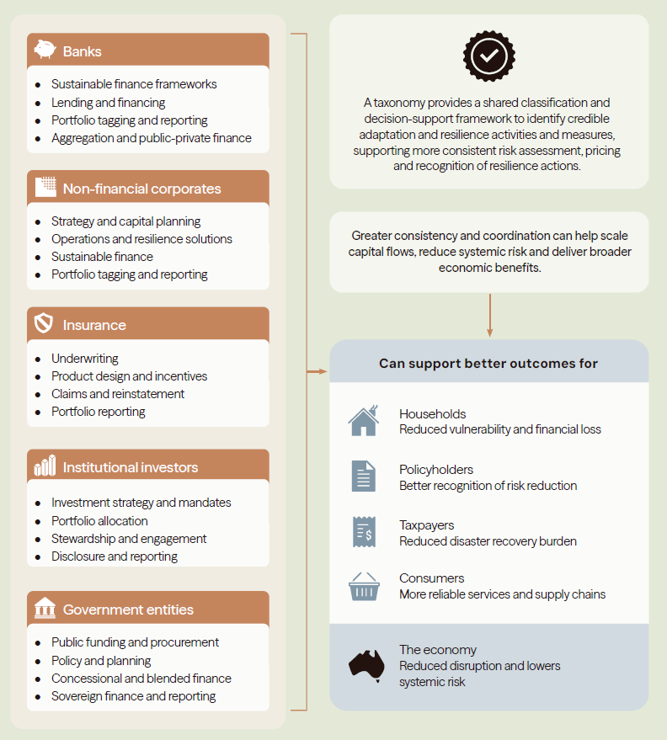
Drawing on engagement with financial institutions, government and technical experts, the report shows how an adaptation and resilience taxonomy could be applied across banks, non-financial corporates, insurance, institutional investment and public finance.
It also illustrates how common criteria could support investment at very different scales, from major infrastructure resilience upgrades to household-level measures, across the built environment, infrastructure, business investment, agriculture and land.
Building the blueprint for an expanded Australian Sustainable Finance Taxonomy
This report forms part of ASFI’s Adaptation & Resilience Taxonomy Scoping Project. Its findings will inform the next phase of work: a blueprint for expanding the Australian Sustainable Finance Taxonomy. The blueprint will include recommendations on priority sectors, themes and activities, and a methodology for developing credible, usable and interoperable technical screening criteria.
The blueprint is expected in Q1 2027 and will provide a proposed pathway for progressing adaptation and resilience criteria within the Australian Sustainable Finance Taxonomy.
View the report below or read the media release.
* Australian Prudential Regulation Authority (APRA), Insurance Climate Vulnerability Assessment (ICVA), 2026.
** Boston Consulting Group (BCG), Landing the Economic Case for Climate Action with Decision Makers, March 2025
*** IGCC, The State of Net Zero Investment 2025