
One year on: Early market applications and use cases of the Australian Taxonomy
July 17, 2026
Australian institutional investors are increasingly searching for diversification, growth, and transition-aligned investment opportunities. Blended finance is a proven mechanism to de-risk investments and create new opportunities for institutional investors in emerging markets.
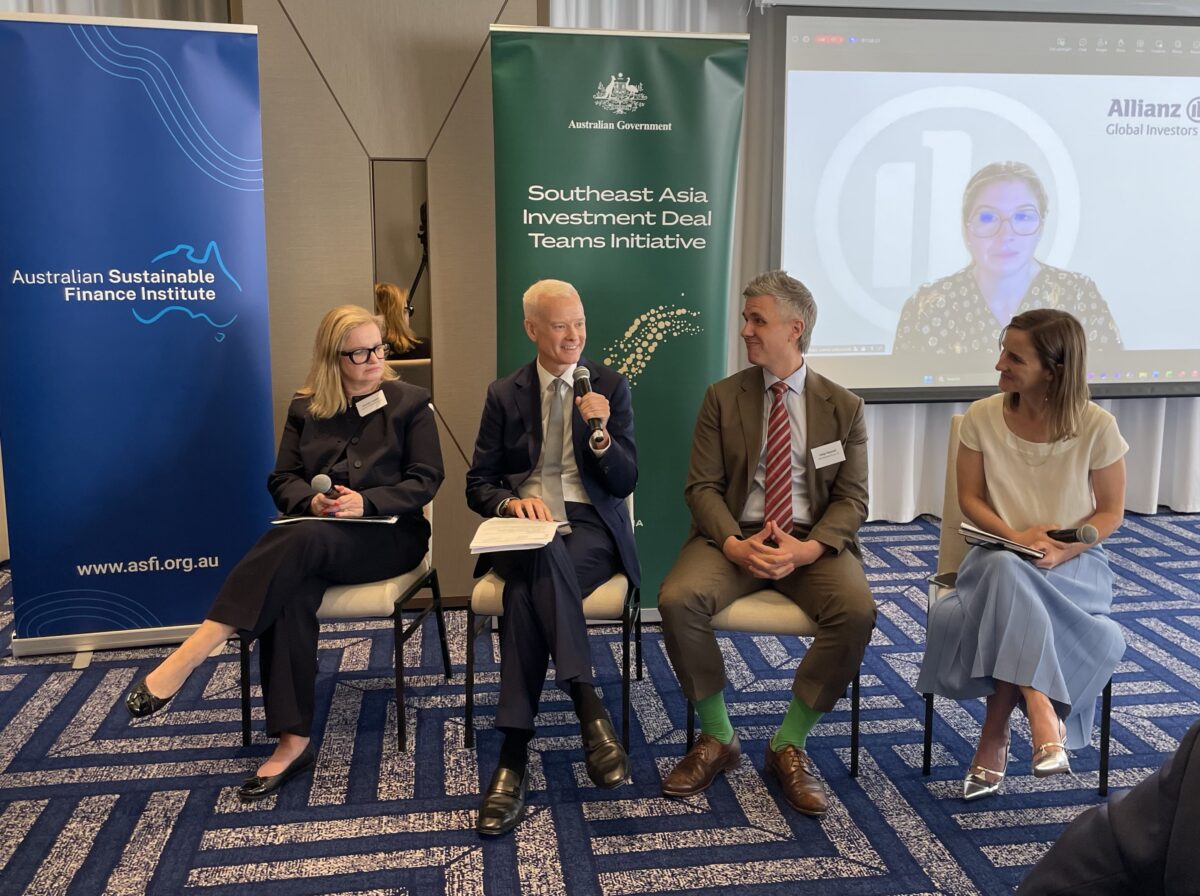
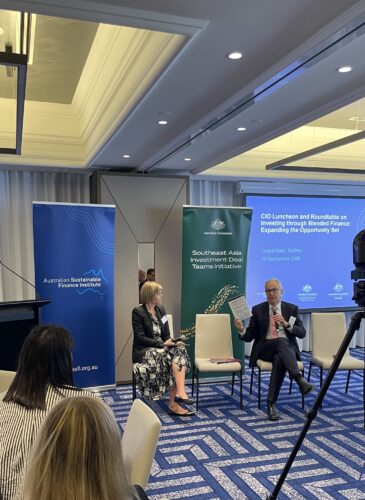
That was the focus of a recent CIO Roundtable on blended finance convened by the Australian Sustainable Finance Institute (ASFI) and the Department of Foreign Affairs and Trade (DFAT), which brought together senior leaders from superannuation funds, asset managers, banks, development finance institutions, and government agencies to explore how blended finance can expand the pathways through which institutional capital can reach emerging markets. Participants were provided with insights into current market practice by several thought leaders, including:
- Nicholas Moore (Special Envoy for Southeast Asia and former Macquarie Group CEO);
- Bertrand Millot (Head of Sustainability, La Caisse Pension Fund);
- Leticia Ferreras Astorqui (Head of Development Finance, Allianz Global Investors);
- Amanda Copping (Chief Investment Officer, Institutional, Export Finance Australia).
- Matt Kaczmarek (Managing Director and Head of Emerging Market Credit Strategy for Global Infrastructure Partners, Blackrock);
- Helge Muenkel (Group General Manager, Climate & Nature, ANZ Bank).
Commercial opportunities are driving use of blended finance
For global institutional investors already active in blended finance, the rationale is primarily commercial. Panellists emphasised that investors are attracted by the combination of portfolio diversification, access to fast-growing emerging economies, and opportunities aligned with climate and sustainability objectives.
Several examples were cited, such as a platform to facilitate international investment in electric buses which mitigated the downside risk for investors with a guaranteed ROI and additional potential upside.
This approach is particularly relevant in Southeast Asia where there is immense planned and ongoing investment in renewable energy, industrial decarbonisation, and infrastructure to support growing populations and rapidly urbanising economies. These trends are creating substantial investment opportunities, but many projects do not attract international private capital due to the traditional risk appetite and portfolio strategy of institutional investors.
Blended finance can help bridge that gap by using catalytic capital to absorb certain risks, improve credit quality, and provide investors with greater confidence when entering unfamiliar markets. Importantly, panellists noted that these structures are intended to act as catalysts for market access and proof of concept transactions that help investors gain familiarity and establish a track record, rather than permanent subsidies.
Blended finance is not new, and it relies on familiar structures and skills
One of the strongest messages to emerge from the discussion was that blended finance does not require a new skill set for financial institutions. While the term may be unfamiliar to some investors, the underlying concepts and structures are already widely used across private markets.
Panellists and participants noted that blended finance often resembles structures already familiar to institutional investors, including structured finance vehicles and securitisation. Investors already have the skills needed to assess and execute these transactions.
Blended finance is not about subsidising poor investments
Panellists agreed that blended finance is not a substitute for sound commercial fundamentals. Government or catalytic capital cannot transform a poor investment into a good one, per the analogy of a ‘smoothie’ where no amount of blending can compensate for rotten fruit. Instead, its role is to address specific barriers such as political, regulatory, market, or currency risks that can prevent otherwise attractive opportunities from being financed at scale.
In this way, blended finance can help to overcome high perceived risk and unfamiliarity with emerging markets by international investors. It also plays a role in building and shaping markets, so that over time catalytic capital is no longer needed to de-risk proven and replicable transactions.
Building confidence in Southeast Asia
Roundtable participants acknowledged that the challenge for many Australian investors is not a lack of investment capability, but a lack of familiarity with Southeast Asian markets. Many attendees observed that Australian institutions are highly experienced in assessing complex capital structures and infrastructure investments, but have had fewer opportunities to engage directly with Southeast Asian project developers, asset managers, and regulators.
Discussions highlighted the importance of local knowledge, trusted partnerships, and access to quality deal pipelines. Participants also pointed to the need for stronger market data and greater transparency regarding blended finance performance, noting that asset owners and investment committees require evidence before committing capital at scale.
At the same time, it was widely recognised that Southeast Asia offers strategic diversification benefits. Participants noted that Australian investors remain underinvested in a region that is expected to play an increasingly important role in the global economy. Many saw growing alignment between climate objectives, portfolio diversification, and emerging investment opportunities across Southeast Asia’s energy transition and infrastructure sectors.
The discussion also highlighted the growing role of governments and development finance institutions in supporting market development. Initiatives such as Export Finance Australia’s contribution of AUD$175 million in debt and equity funding through Singapore’s Financing Asia’s Transition Partnership (FAST-P) and the Australian Government’s $2 billion Southeast Asia Investment Financing Facility (SEAIFF) were cited as examples of efforts designed to reduce barriers and mobilise private investment into the region.
The time to participate in blended finance is now
Blended finance is increasingly being designed to attract institutional capital, and the Australian Government is actively supporting strategies and investments that ‘unlock’ Southeast Asia as an investable market. For institutions looking to build out their emerging market strategies in the region, now is the time to take advantage of concessional capital, alongside other government advice and support. The view was expressed that this must occur in the near future to 2030, to secure opportunities while derisking is available rather than entering later, without any protections, concessional capital or track record of in-market experience.
Latest News

October 7, 2026