Hong Kong SAR remains a critical bridge into China’s sustainable finance market
ASFI and a consortium of Australian and Chinese partners have convened the third workshop in the Australia-China sustainable finance dialogue series in Hong Kong SAR. Together with the earlier workshops in Beijing and Canberra, this workshop focused on developing a shared language to inform bilateral cooperation.

Hong Kong SAR plays a central role as China’s primary international financial centre, and is the key bridge into the country’s sustainable finance market. This position provides a practical pathway for high-integrity investment and expertise-sharing between Australia and the region, and has firmly established Hong Kong SAR as a major sustainable finance hub in the Asia Pacific.
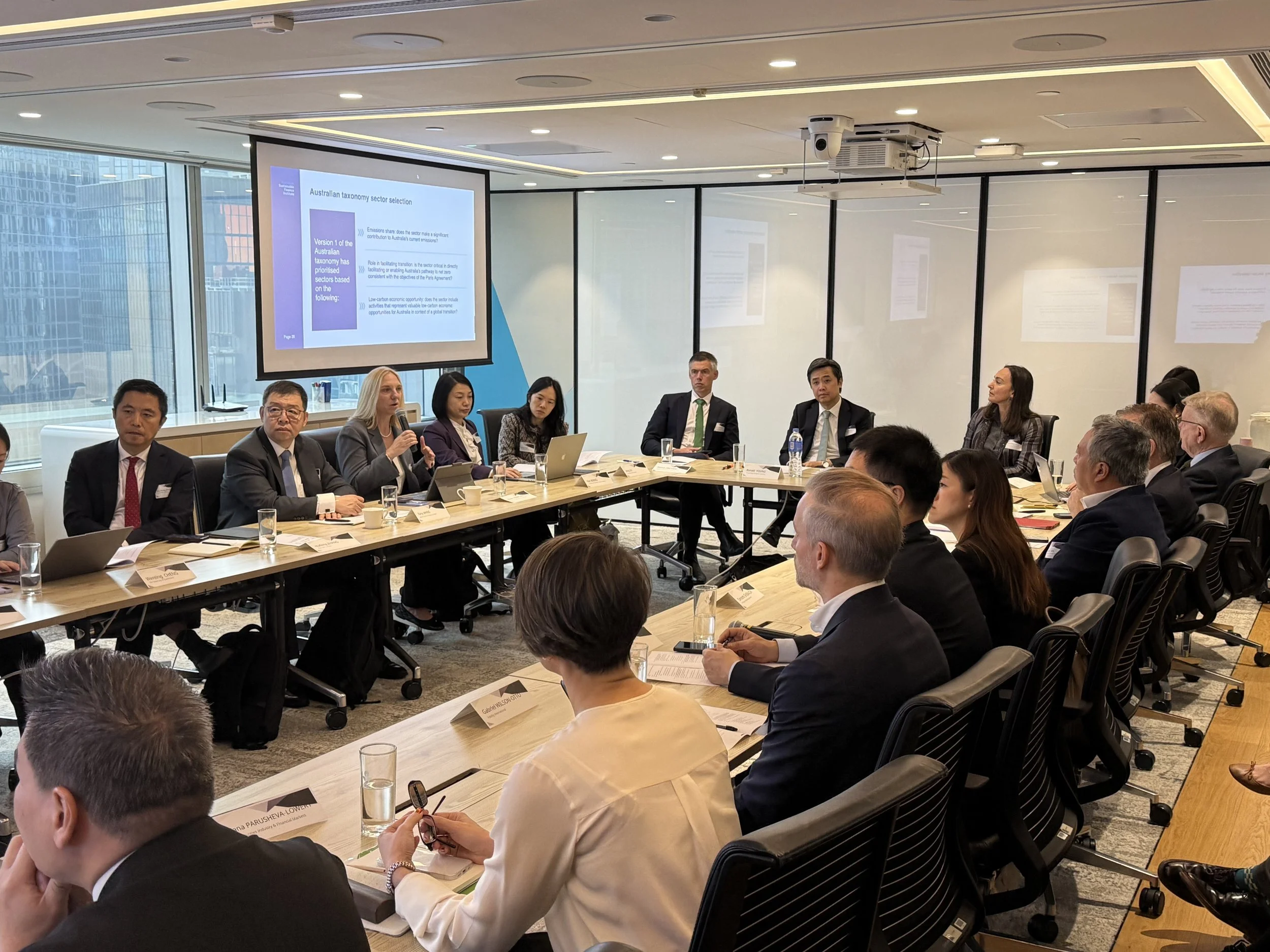
The workshop, funded by the National Foundation for Australia-China Relations (NFACR), brought together financial institutions, policymakers and academics during ASFI’s visit to Hong Kong in December.
The workshop was hosted at the offices of ASFI Member ANZ, and organised by the Central University of Finance and Economics’ International Institute of Green Finance, the University of Western Australia, the University of Queensland, the Australian National University (ANU) and the Australian Sustainable Finance Institute (ASFI).

Shared taxonomy approaches
The workshop opened with a discussion of Hong Kong SAR’s latest sustainable finance reforms, including updates to its Sustainable Finance Taxonomy. Presentations were delivered by the Hong Kong Monetary Authority, Hong Kong Green Finance Association and Shenzen Green Finance Association.
“What continues to emerge across these workshops is the growing alignment in how both jurisdictions are approaching sustainable finance frameworks,” said Nicole Yazbek-Martin, Executive Manager at ASFI.
“Hong Kong SAR and Australia are each building taxonomies that offer practical, credible definitions of green and transition activities, to ensure financial institutions have the confidence to assess investment opportunities consistently across borders.”
“A shared language for transition finance is essential. Not only to support capital allocation decisions, but to strengthen the integrity of the broader sustainable finance architecture across Australia and China.”
Market innovations and shared examples of success
The workshop also provided space for institutions to share emerging market practice and the latest developments in sustainable finance instruments across the region.
Sessions included:
A presentation on the Bond Connect platform including CGT-aligned green bonds from the Bond Connect Company Limited;
Case studies on major cross-border green bond issuances from the Hong Kong Mass Transit Railway and CLP Power;
Case studies of mobilising capital behind green funds, including with Common Ground Taxonomy labels by JP Morgan Asset Management and Fidelity International; and
Sharing practices on mobilising cross-border sustainable capital between Australia, Hong Kong SAR and mainland China by ANZ, Bank of China, JP Morgan, HSBC, China Merchant Bank and Ping An Group.
“ANZ was pleased to be able to contribute to such an important discussion,” said Stella Saris-Chow, Head of Sustainable Finance (International), ANZ. “Hong Kong SAR plays a critical role in the region’s sustainable finance system, and forums like this help to build interoperability, credibility and capability across markets.”
The insights from the Hong Kong session will be incorporated alongside those from Canberra and Beijing, to inform the development of an Australia-China Sustainable Finance Roadmap, which will outline recommendations for ongoing collaboration.